From Transcript to Interview Report: AI That Transcribes and Then Summarizes

- Key takeaways
- What does "transcript to report" actually mean?
- How the pipeline works: four steps
- Why transcription isn't your problem anymore
- Where it breaks: the summary isn't neutral
- What a good interview report contains
- Accuracy, hallucination, and GDPR
- How to choose a tool
- From transcript to a CRM-ready report
Key takeaways
* A tool that "transcribes and then summarizes" runs four steps: record, transcribe, summarize, and structure. Most tools nail the first three and skip the fourth.
* Transcription is largely a solved problem. AI now matches human accuracy on speech recognition; today's error margin lives in the summary, not the transcript.
* A summary is a block of prose. An interview report is structured data: competencies, motivation, availability, salary expectation, each field separate and traceable back to the conversation.
* For recruitment that difference is everything. You read a summary once; a report feeds your ATS, your shortlist, and the handover to the hiring manager.
Choose a tool on what happens after* the summary: does the data land structured in your system, is every field traceable, and is it GDPR-compliant?
What does "transcript to report" actually mean?
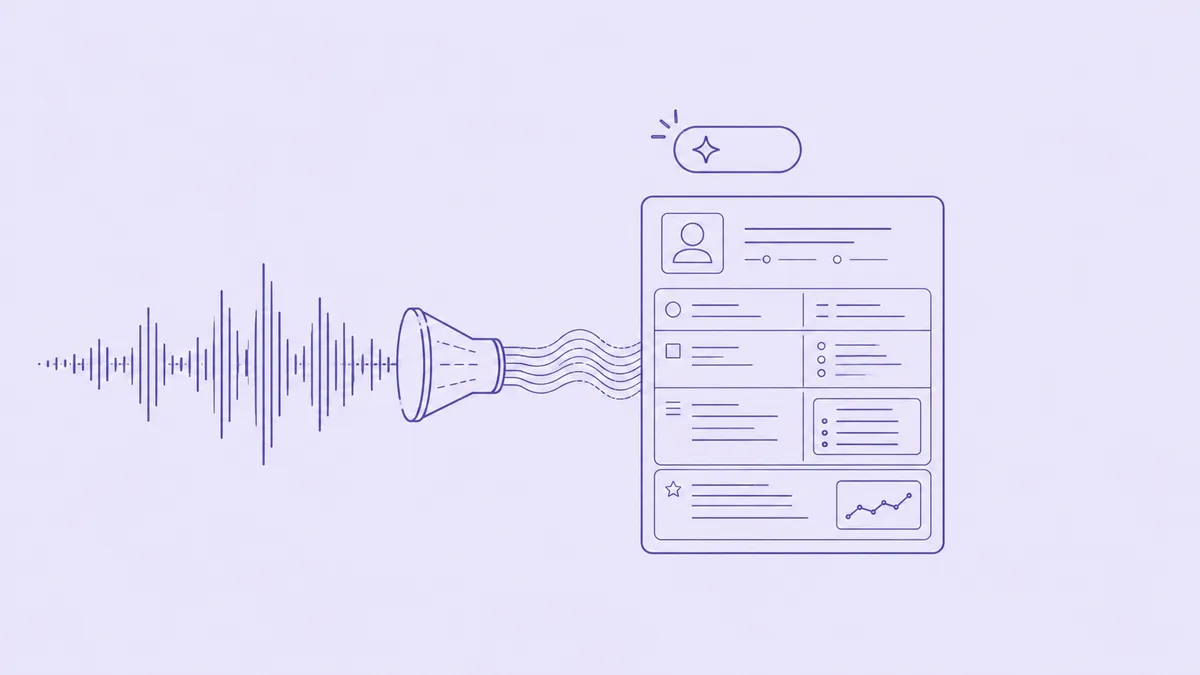
Transcript-to-report is the workflow where a recording is first turned into text word for word (the transcript) and then distilled into a structured document you can act on (the report). The difference from a plain summary is structure: a report places information into fixed fields, while a summary leaves it in free-flowing text.
Those two words get used interchangeably, and that is exactly where tools mislead you. "Transcribes and summarizes" sounds complete, but it usually produces a paragraph of prose: nice to read, hard to use. A recruiter doesn't need a paragraph. They need a record where the salary expectation sits apart from the notice period, and the notice period apart from the reason for leaving.
For an interview, then, "report" means something specific: turning what was said back into the building blocks of a hiring decision. How does the candidate map to the role, where is the doubt, and what is the logical next step. That is the step generic note-taking tools almost never take.
How the pipeline works: four steps
Every tool that transcribes and summarizes runs the same four steps. They look identical in every demo, but the quality gap between steps is enormous. Knowing what happens at each stage tells you exactly where a tool is strong or weak.
- Record. The conversation is captured, via a meeting bot in Teams or Meet, a desktop or mobile app, or a phone line. Quality here governs everything downstream: noise, a bad connection, or people talking over each other cascade through the whole pipeline.
- Transcribe. Speech becomes text. Modern speech recognition separates speakers (diarization), adds punctuation and timestamps, and handles accents. This is the most mature step technically.
- Summarize. A language model compresses the transcript to its essence. This is where the first room for error opens up: a model can drop nuance or, worse, add something that was never said.
- Structure. The summary is pulled apart into fields: competencies, experience, availability, motivation, next actions. This is the step that turns a summary into a report, and the step most tools skip.
The first three steps have become a commodity. Dozens of tools do them decently to well. Step four is where the real difference lives, because that is where text finally becomes data. And data is the only thing your ATS, your shortlist, and your colleagues can use.
Why transcription isn't your problem anymore
It's tempting to compare tools on transcription accuracy, but that battle is largely won. Back in 2017, Microsoft reached a 5.1% word error rate on the Switchboard benchmark of telephone conversations, matching a team of professional transcribers. That benchmark matters for recruiters: it measures spontaneous, informal phone calls, exactly the kind of screening call you run all day.
The manual work AI replaces is substantial. Transcribing one hour of conversation verbatim takes a skilled person more than six hours on average, and that's before you've turned it into anything useful. AI does that step in minutes. So the question is no longer whether the machine can get your conversation accurately into text. The question is what happens to it next.
And that is precisely where the new error margin has moved: to the summary.
Where it breaks: the summary isn't neutral
The biggest risk in the pipeline sits not in the transcript but in the summary step, where a language model decides what matters and what doesn't. A model can omit a key detail, conflate two candidates, or add a fact that was never stated. That last one is called hallucination, and it isn't rare.
Even the best-performing language models still introduce information that isn't in the source in roughly 1 to 2% of their summaries; many models sit well above that. Sounds small, until you consider what it means for a hiring decision. One invented "five years of Python experience" in a summary nobody checks against the transcript, and you advance the wrong candidate. At volume, that adds up.
| Summary | Interview report | |
|---|---|---|
| Form | Free text, a paragraph of prose | Structured fields |
| Usable in ATS/CRM | No, you retype it | Yes, fields map directly |
| Verifiable | Rarely; you trust the text | Every field traceable to the conversation |
| Decision-grade | Limited | Yes, that's the point |
| Where tools stop | Here | Here the real work begins |
The point isn't that summarizing is worthless. It's that a summary is a reading product, not a deciding product. The moment you base a hiring decision on it, you want two things prose doesn't give you: structure and traceability. Structure so the data lands somewhere. Traceability so that when in doubt, you can go back to the source and check whether it holds.
What a good interview report contains
A usable interview report turns the conversation into the fields you actually decide on, not into a story. For a recruitment intake or screening call that means a handful of fixed blocks that recur every time, so you can line candidates up side by side instead of comparing four walls of text.
Hard criteria.* Availability, notice period, salary expectation, location, contract type. The knockouts, separate and searchable.
Competencies and experience.* Not "spoke well about projects," but which skills were demonstrably covered, linked to the moment in the conversation.
Motivation and context. Why* the candidate wants to move, what they're looking for, what's holding them back. The soft signals that predict whether someone actually switches.
Red flags and doubts.* What you still need to check, explicitly, so it doesn't disappear under the enthusiasm.
Next action.* Advance, reject, second interview. With the reasoning underneath.
Notice that this is exactly the information a good recruiter already holds in their head during the conversation. The problem is never that the recruiter doesn't know it; the problem is that it stays in scattered notes and memory instead of landing in the system. A report workflow captures it the moment it's said. Want to go deeper on the structure of such a write-up: we wrote a separate guide on writing the interview summary, with templates.
Accuracy, hallucination, and GDPR
The moment a tool decides what goes into the report, you carry a responsibility that goes beyond convenience. Candidate data is personal data, and a conversation you record and process falls under GDPR. The EU AI Act also classifies AI used in recruitment and candidate selection as high-risk, with obligations around transparency, human oversight, and data governance phasing in.
In practice that means three things. One: you must be able to show where a data point came from, so traceability from report to transcript to audio isn't a luxury but a compliance requirement. Two: a human must keep the final judgment; a report is input for a recruiter, not an automatic rejection. Three: you need to know where the data lives and whether it trains your vendor's models. Ask that explicitly, because the answer varies sharply between providers. More on this in our guide to the EU AI Act and GDPR for recruitment tools.
How to choose a tool
Judge a transcribe-and-summarize tool not on the transcription, but on everything that comes after it. The transcription is good enough in nearly every serious tool. The distinction lives in the structuring step and the safeguards around it. Run each vendor through these five checks:
- Does the tool stop at prose or deliver fields? Ask for a sample report. If you get a paragraph, you're still doing the step-four work yourself.
- Is every data point traceable? Can you go from the report back to the exact sentence in the transcript and the audio? Without that line you can't verify anything and can't defend anything.
- Does it land structured in your ATS or CRM? A report stuck in a separate tool creates the very data silo you were trying to escape. Integration is half the product.
- What happens to the data? GDPR by design, clarity on the EU AI Act, and a clear answer on whether your conversations train their models.
- Does it work across all your channels? Video intakes, phone screening, on-site conversations. A tool that only handles Zoom calls misses half the recruitment work.
It comes down to one question: does the tool leave you with a readable story, or with usable, verifiable data? The first saves you five minutes of typing. The second changes how you work.
From transcript to a CRM-ready report
The whole pipeline hinges on the last step. Recording, transcribing, and summarizing have become a commodity; dozens of tools do it fine. The difference between a tool and a working workflow is what happens after the summary: does the text become structured, traceable data your system can ingest, or does it stay a paragraph you have to retype by hand.
Here it helps to be precise about what Simply does. Simply records conversations across any channel, meeting bots for Meet and Teams, a desktop and mobile app, and VOIP for phone calls, and turns them not just into AI summaries but into structured fields via smart CRM data-entry. Every field is validated as certain or uncertain, and every detail stays traceable to the moment it was said: click a sentence and you hear the audio. That is exactly the step four generic note-taking tools skip, and it's why the output is a report rather than a paragraph.
Simply is the recruitment-intelligence co-pilot that keeps a clean line from conversation to CRM: meeting bots (Meet/Teams), desktop app, mobile app, and VOIP; ISO 27001-certified, GDPR-compliant, and it never uses your data to train models. Curious how that looks in practice? Read the complete guide to AI interview transcription or see how conversation intelligence turns scattered conversations into usable data.