Recruitment Software in 2026: The Types and How to Choose

In short
* Recruitment software is an umbrella term for tools that support the whole journey from open role to signed offer. At least five distinct types sit under that name, and most teams need more than one.
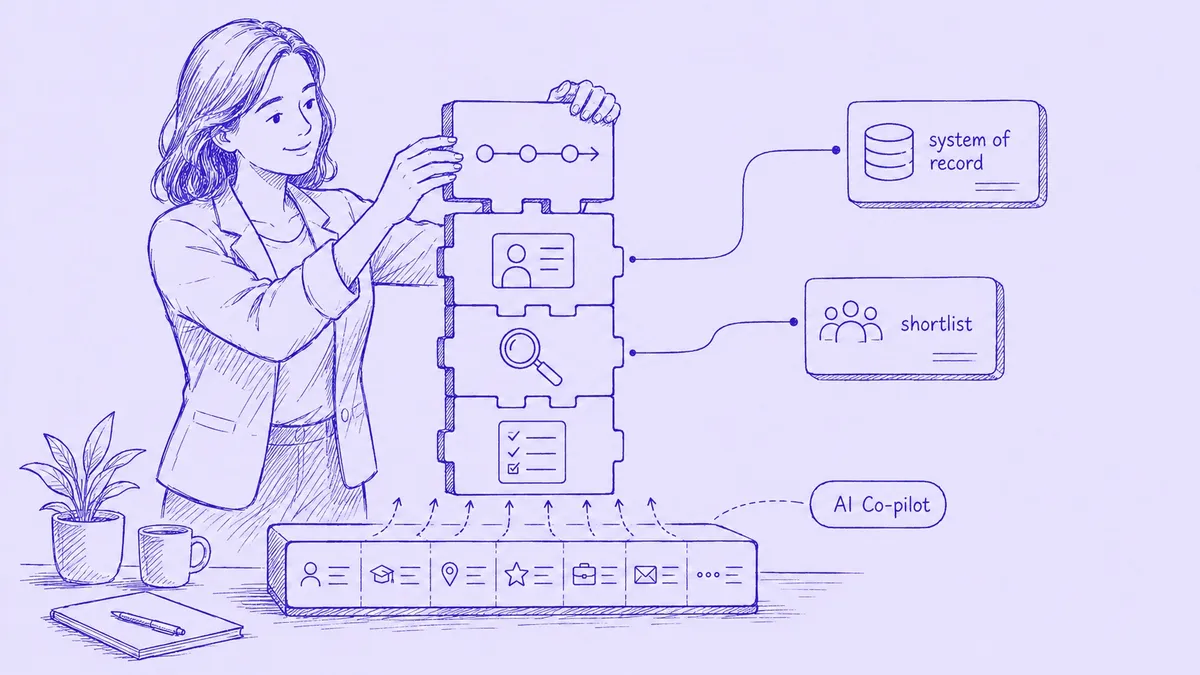
* The core distinction is between a system of record (an ATS or CRM, where you manage candidates and process) and the layers on top of it: sourcing, screening and AI insight.
* Prices range widely, from free entry tiers to bespoke enterprise contracts. Price tells you little about fit; the real question is which type solves your biggest bottleneck.
* A keyword-driven ATS is strong at admin but weak at judgment. Research shows these systems filter out qualified candidates who do not match the exact criteria.
* Choose on your team type, your volume and the quality of the data you feed it, not on the longest feature list.
What is recruitment software?
Recruitment software is software that supports the process of finding, assessing and hiring candidates, from the first job posting to the signed contract. In practice it is not a single product but a category: applicant tracking systems, recruitment CRMs, sourcing tools, screening software and, more recently, AI assistants that turn conversation data into usable information.
It helps to pull the two halves of hiring apart first, because the recurring question "what is the difference between recruiting and selection?" comes up for a reason. Recruiting is everything you do to bring candidates in: posting roles, sourcing, employer branding, working your network. Selection is what comes after: screening, interviewing, assessing and choosing. Some software is strong at the first half and weak at the second, or the other way around. Knowing which half your bottleneck sits in tells you which type you need.
And that is exactly where most comparison lists go wrong. They put an ATS, a CRM and a sourcing tool in the same table as if they compete, when they do different jobs. You do not buy "the best" recruitment software. You assemble a set that fits how your team actually works.
The types of recruitment software
There is no single kind of recruitment software. Most products fall into one of five categories, and larger platforms stitch a few together into one suite. Knowing which type you are looking at tells you exactly what it will and will not solve for you.
| Type | What it does | Best used for | Main limitation |
|---|---|---|---|
| ATS (applicant tracking) | Records and manages applicants through the pipeline | Corporate recruitment, high application volume | Traditionally matches on keywords: strong at admin, weak at candidate insight |
| Recruitment CRM | Manages relationships with candidates and clients over time | Agencies: search & selection, staffing, contracting | Built for relationship management, not deep selection |
| Sourcing & matching tools | Finds and approaches passive candidates (LinkedIn, databases) | Scarce roles, active sourcing | Fills the top of the funnel, does nothing for selection or the record |
| Assessment & screening tools | Test skills or screen CVs, return a ranked shortlist | High-volume pre-selection | Only as good as the data and bias controls underneath |
| AI intelligence layer (co-pilot) | Captures conversations and turns them into structured, validated data | Any team that leans on conversation data | Not a system of record; works on top of your ATS or CRM |
Notice that each type touches a different part of the work. An ATS and a CRM are your system of record: they hold who you know and where they sit in the process. Sourcing tools fill the top of the funnel. Screening tools sift the bottom. And the AI layer does something the other four almost never do: it reads the conversation itself, the intake call and the interview, and turns that into data the rest can use. Hold that last point, because the rest of this guide turns on it.
On the agency side, two guides go deeper here: what a modern ATS has to do in 2026 and AI tools that work with your existing ATS.
What does recruitment software cost?
The price of recruitment software ranges widely, from free entry tiers to bespoke contracts of thousands per month. There are broadly three pricing models: per user per month, per role, and freemium. Which model fits depends on your team size and your volume, because the model often tells you more about the target buyer than the number does.
Per user per month.* The most common model for ATSs and CRMs. You pay for each recruiter who needs a seat. Fine when your team is stable, expensive when you scale up and down fast.
Per role or per job slot.* You pay for the number of open roles. Suits organizations with fluctuating volume that do not want to be locked into seats.
Freemium or free tier.* Some tools offer a free version capped on users or roles, designed to bring you in. Good for testing, rarely enough to run an agency on.
Remember the licence is not the only cost line. Implementation, data migration, integrations with your other systems and training all add up, and with enterprise platforms those sometimes land higher than the subscription itself. Always ask for the total cost across the first year, not the monthly price on the pricing page.
One point of confusion is worth clearing up. The question "how much does recruitment and selection cost?" is sometimes not about software at all, but about outsourcing the hiring itself. A search-and-selection agency typically charges 20 to 25 percent of the gross annual salary per successful placement. That is a very different number from a software subscription, and it is worth knowing which of the two you are actually comparing.
How do you choose the right recruitment software?
Choose recruitment software on your biggest bottleneck, not on the longest feature list. A tool that does ten things halfway loses to one that solves your single real problem well. So start with the question: where does it break down for us, finding candidates or assessing them?
From there, let your team type guide you:
- Corporate recruitment, high volume. Your biggest burden is admin and oversight. Start with a strong ATS and look hard at how well it integrates with your HR system.
- Search & selection or contracting agency. Relationships are your capital. A recruitment CRM that holds candidate and client contact over years matters more than a tidy application form.
- Staffing and high-volume placement. Speed and matching at scale count. Look for strong sourcing and a clean link between demand and supply.
- Scarce roles and executive search. Your bottleneck is in finding, not managing. Sourcing tools and the quality of your conversation record do most of the work here.
Then run one hard test across all of them: does the tool write back cleanly into the systems you already have? A score or a candidate stranded in a separate tool creates the exact data silos you were trying to escape. How integrations make or break your stack is worked out further in our guide to AI tools and ATS integration and in ending fragmented recruitment data.
There is one limitation you should not skip when choosing. An ATS that matches on literal keywords is strong at admin but weak at judgment. In the Harvard Business School and Accenture study "Hidden Workers: Untapped Talent," 88% of employers agreed that qualified, high-skilled candidates are filtered out of their process by screening software because they do not match the exact criteria. These are not rare exceptions: the same study counted more than 27 million such hidden workers in the United States alone. Software that filters out people you should have spoken to is not a time saving, it is a leak.
What AI changes about recruitment software in 2026
AI shifts the center of gravity of recruitment software from recording to understanding. The old system tracked who applied and where they sat in the process. The AI layer arriving now tries to read what happened in the conversations: why a candidate wants to move, what doubt the client had, which requirement is genuinely hard and which is negotiable.
That is a real step forward, but it comes with an obligation. Recruiters are under pressure and decide fast; eye-tracking research from Ladders found a first CV scan lasts an average of just 7.4 seconds. AI that takes over that first sift can make that haste fairer or harsher, depending on what it was trained on. That is exactly why the EU AI Act classifies AI used for recruitment and candidate selection as high-risk, with obligations on transparency, human oversight and data governance phasing in through 2026. If you buy software with AI features in 2026, you buy that obligation with it. Ask every vendor where candidate data is stored, whether it trains their models, and whether the tool can explain why it reached a judgment. What compliance means in practice for recruitment tools is covered in our guide to the EU AI Act and GDPR.
The thread through all of it: AI makes the software smarter, but only as smart as the data going in. And that is where most stacks have their real gap.
The layer most recruitment software misses
Ask a recruiter where the best information about a candidate lives, and the answer is almost never "in the system." It is in the intake call, in the interview, in that phone call where someone explains why they actually want to leave. That is the richest signal in the whole process, and it almost never becomes structured data. It stays in someone's head and in loose notes. So your ATS manages a record that is missing half the story, and your AI tools reason over that same half record.
This is why data quality is the layer beneath all the others. A cleaner record beats a cleverer algorithm nearly every time. Three things decide whether your software rests on solid ground: whether conversation data actually lands in your system, whether you know which fields are reliable, and whether you can trace where each detail came from. When those are fragmented, every tool on top amplifies the gaps. We worked that mechanism out in recruitment intelligence and in conversation intelligence for recruitment.
Here it is only fair to be precise about where Simply sits. Simply is not an ATS and not a CRM, and it does not replace your recruitment software. It works one layer earlier, on the data all those systems rest on. It captures conversations across every channel, turns them into structured fields with CV parsing and smart CRM data entry, validates each field as certain or doubtful, and writes it back cleanly through integrations into the system you already use. Whatever software you choose, it works on a complete record instead of a keyword-thin CV.
From a tool list to a choice that fits
Recruitment software is not a single purchase but a stack, and the best stack is not the most expensive or the longest. It is the smallest set that solves your real bottleneck. So do not start with the feature list, start with the question of where it breaks down for you: in finding candidates, in assessing them, or in the messy data between the two.
Choose your system of record on integration and on how well it talks to your existing stack. Choose your AI features on transparency and compliance, not on the promise. And do not forget the layer underneath, because every tool you stack on top is only as good as the data you feed it. Get that foundation clean and your software becomes an assistant. Leave it fragmented and it becomes an expensive way to widen the same gaps.
Simply is the recruitment-intelligence co-pilot that keeps that foundation clean: meeting bots for Meet and Teams, a desktop and mobile app, and VOIP for phone calls, with per-field validation and a traceable line back to the source. ISO 27001 certified, GDPR compliant, and without using your data to train models. Curious how clean conversation data makes your existing software better? See how Simply works.